New Pacific 52 class makes its debut in San Francisco
by Richard Gladwell, Sail-World.com NZ on 18 Mar 2017
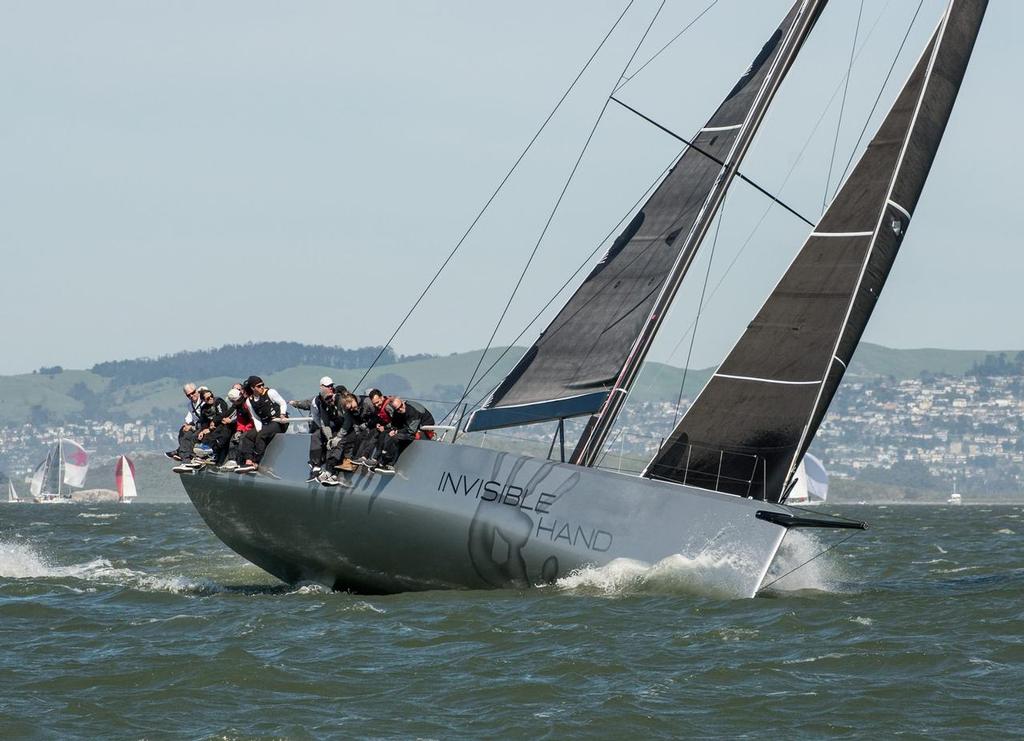
One of new Pacific 52 class, Invisible Hand, racing in San Francisco - March 2017 Erik Simonson/ pressure-drop.us
http://www.pressure-drop.us
The first of two new-build Pacific 52's from Auckland's Cookson Boats is now sailing in San Francisco.
Invisible Hand for San Francisco's Frank Slootman replaces his earlier RP63 of the same name. She will soon be joined by a second Cookson build, Bad Pack (Tom Holthus) from the same moulds.
A third, RIO 52 is for RIO 100 supermaxi owner Manouch Moshayedi.
The three new builds will join three existing 52fters to form the nucleus of a new level rating Pacific 52 fleet racing in the West Coast of the USA.
Around 16 years ago a similar concept, the Transpac 52 had similar aims and origins, but the TP52 soon evolved into a Mediterranean based MedCup inshore racing class, before being re-badged as the SuperSeries52.
Mick Cookson describes the Pac52 as 'an offshore version of a Medcup TP52, which is now known as a Super Series 52'.
That may seem like a 'return to the future' type remark, given that the TP52 had its origins in the San Francisco, started life as the Trans Pacific 52 and was designed for the biennial Trans-Pacific Race from Los Angeles to Hawaii,
Learning from the earlier experience, the Pacific 52 is an attempt to set up a level rating class box rule that will work within existing rules, principally ORR - a US version of ORC.
'We want to put the boats back to what they were meant to be,' explains Bill Erkelens, project manager for two of the Pac52's built in Auckland by Cookson Boats. A third, RIO 52 was built in Dubai, also for a US owner.
All three carry a spar and rigging package from Hall Spars and Rigging (NZ), with Doyle Sails NZ supplying the sail inventory for the first to be exported, Invisible Hand.
Early TP52's like the Auckland owned V5, designed by Alan Andrews, still race. V5 enjoys a highly successful racing life after being converted to a canting keel - a move which dropped her out of class.
The two Auckland built boats are essentially a Volrijk Super Series 52 hull, with some modifications and with a Cookson design deck, based on the yard's extensive experience with the type, but also the highly successful Cookson 50, which is still placing well in premier offshore races.
The Pac52 will feature a fixed keel.
The canting keel was considered as an option, these boats are based on an earlier West Coast 52fter Fox, and what Gavin Brady has done with Beau Geste and they are fine with a fixed keel. Inshore racing with IRC, you are not going to be competitive with a canting keel. '
'We 've increased the freeboard of the hull - so the crew can actually get into the bunk, and there is also access to the are under the cockpit floor to a navigation station,' explains Mick Cookson.
'Most of the sail control systems are either on deck or sealed,' he adds in deference to producing a seaworthy offshore racer.
A one design to tick all boxes
The Pac52 project arose after professional skipper, Gavin Brady, had discussions with a potential owner who was considering buying a second-hand SuperSeries 52 and converting that for IRC racing and some SuperSeries events, but no offshore racing.
The upshot of that conversation was that it was probably easier to build a low-cost new boat with all the features that would have been required in the SuperSeries52 conversion.
'The owner knew of three others in California that were looking to undertake a similar conversions,' says Erkelens.
'We had already had concept plans done for an ORR boat aimed specifically at Trans Pac and the races to Mexico. Then they all got together and said 'why don't we have a one-design that would tick all boxes?'
'You can go to Mexico and Hawaii, I can have a boat that will race around the buoys, and we can have a boat that is more suitable for the type of sailing we do on the West Coast of the USA, rather than the Mediterean.
'They all agreed, and this three-boat Pac52 project was born.'
'Because the boats and deck layouts have been compromised and heightened - we can race offshore, or we can race inshore.'
'This Pac52 concept is conducive to both formats of yacht racing', Mick Cookson chimes in.
'We eliminated as much of the swiss-cheese as we could from the deck,' Erkelens continues.
'The Vrolijk decks are flat, so they help us with lines on deck rather than everything going down below and back to the cockpit.'
'We have steering compasses, galleys, toilets and nav stations that are all removable for inshore racing. We also can remove the wheels and plug in a tiller for inshore racing and then put a wheel back for offshore racing.'
'It was very affordable to do all this down in New Zealand at Cookson Boats. It has been an excellent experience, ' Erklens adds.
The hull is the same Vrolijk design as the well performed SuperSeries52 Provezza. 'I re-drew the deck - just to make the interior work,' explains Cookson.
'We took a couple of sections, played around with a few different freeboard heights, and overlaid the sections with a Super Series boat to make sure you could get into the bunks, and under the cockpit floor. All we did was to start with the middle of the boat - see if that works, and then that basically dictates the freeboard at the bow and stern.
'We did a similar thing with Georgia off the Team New Zealand 52fter.'
'We lifted the freeboard 150mm in the bow and 125mm in the stern.'
'It is all going to help shed water', adds Bill Erkelens. 'All our races are downwind in California. We go downwind to Hawaii, downwind to Mexico - we do delivery or truck back up wind!'
'We only race towards the Equator! That's our rule!'
'We also didn't want to be submarining when the squalls come through in the afternoon - so the bunks go all the way up to amidships.'
'She will be perfect for Sydney Hobart, Fastnet, Middle Sea race - all the Blue Water Classics,' says Cookson.
Mick Cookson says he has had interest from outside the West Coast of USA. 'We have interest from a broader sector, particularly IRC - from England and Australia asking when will there be a Cookson 52?
' Plus there are other people in California who are interested.'
[Sorry, this content could not be displayed]
More gears than a Super Series 52
He also notes that this Pac 52 will go well upwind as well as downwind.
'She has a bigger taller rig than a Super Series boat - so she should have a few more gears in the gear-box than a Super Series boat.'
His one concession to the Super Series 52 boat is in the righting moment because the deck is higher - but says with the increased crew weight that too could even out.
The Pac 52 will run nine crew offshore and 15 in the inshore races.
'To a large extent, this is an evolution and development of what Gavin Brady has done with Beau Geste.'
Fox, a Botin design, and a recent TP52 export from Cookson, now racing out of the West Coast USA is a sistership to Beau Geste 'plus wheels and bits and pieces'.
The decision to go with a Vrolijk hull for Invisible Hand and her sister ships was made on the basis of feedback from sailors in the Super Series.
'You try and put filters on all that, and sort out the information and opinion', says Erkklens 'and this is more of an all-round hull.'
'We only go downwind. The flat deck is nice for waterproofing offshore.
'We did go back and forth, it was a close decision - the initial designs we had were for a strictly ORR boat, and that was a Botin design.
'But Rolf Vrolijk was willing to work with us more closely. While there has been a lot of emphasis on one design and we had a lot of input not to lose track of the ORR rating rule, and Gavin Brady's experience has all been with IRC - so he was keeping that in mind.
'We moved the rig back a little to increase the J-measurement' says Erkelens - 'which is an advantage under ORR, and a smaller mainsail is a big advantage.'
'We can always chuck a bigger mainsail on if we want, and we already have the bigger J-measurement and keep the same size kites.
'We wound up with 90-95% of what we wanted for just ORR, but we picked up one design and even-rating with the three existing boats including Fox, Beau Geste, and also there is Vesper, which has the tall rig and deep keel already, So they are close to our rating band.
'Plue we have Invisible Hand, Bad Pack, and a Rio 52, a sistership being built by Premier - so we have six boats that could potentially race on the West Coast on a boat for boat basis.'
Class being formalised
Currently, the Pacific 52 rule is being written. It will be a boat for boat rule, level rating box rule, allowing for design differences but at equal rating and within that rule there will be the opportunity for one designs to be built with the obvious advantages in reduction in tooling and building costs, plus other measures aimed at cost reduction without affecting performance in a measurable way.
'We're going to have owner drivers, limited professionals (seven) and boat for boat racing,' explains Erkelens. 'But is all in draft form.'
He believes the Pacific 52 is the best chance the West Coast has had in a long time to develop a rule and boat type and build a fleet that will interest owners, control costs, and give excellent inshore and offshore racing.
Obviously, with good fleets of fifty footers in New Zealand and Australia, there is a good opportunity to expand already strong fleets around the Pacific Rim, and also into UK and Europe.
'There are moulds for the Super Series 52's around the world that can be used to take boats from,' says Erkelens. 'They can take last year's Super Series boats and put a deeper keel and taller rig in.'
'Or, they can take an existing Super Series boat, and jack the rig up,' adds Cookson.
However, both point out that the last generation of Super Series hulls are designed only for inshore racing and could not be raced offshore.
'We want people who don't want to spend $4million on a boat and then another million or three racing it each year. We want people who want to build a boat and go for a yacht with it, and not have containers full of gear, and professional teams showing up to keep it running and then not being able to race offshore', says Erkelens.
'The Pacific 52 is pitched at a high-level club sailor, not a full professional race team,' adds Cookson.
'Even if the class fizzles, you will still have a very good boat,' says Erklens. 'We can race it to Mexico and Hawaii for the next ten years, and it will still be very competitive.'
'The ORR has done a good job for us. As long as we don't go out of bounds with any of the ORR parameters, we will have a good boat that will have a long life winning races.'
Cost control a significant feature
The key with the Pacific 52 is to keep the fundamentals right.
One of those is cost - which Cookson puts at anywhere from between $US1.5-2.5million. 'The variables start everywhere from the rig to systems and construction,' says Mick Cookson.
He puts a Super Series 52 new build at $US3million.
Invisible Hand has foam core for the hull rather than Nomex. Foam being a little cheaper and more robust and makes very little difference to weight. The Cookson boats have a honeycomb deck, but a cheaper boat would have a resin infused hull and deck structure with a foam core. Cookson puts the weight difference between the two options at about 100kgs.
'If the owners decide that it is super critical to have equal righting moment then any weight differences can be evened out by controlling the keel depth for each boat, so the righting moments are all the same,' says Cookson.
'We haven't measured anything yet, but we are very keen to match Fox, as the first existing boat - and we don't want to make her obsolete,' explains Erkelens. 'We have more freeboard than Fox, so we might go for a bit more keel depth to get the centre of gravity in the right spot, for instance.'
'We can do that with different crew weights or a different draft. We also have a pocket that can be used to adjust bulb weight,' he adds.
'We will make adjustments so that theoretically the boats will all be the same speed.'
Erklens says that Invisible Hand will launch with the shallowest draft and lightest bulb and with all the bunks, galley, nav station and watermaker, and she will get a measurement certificate in that mode for Hawaii.
For her inshore mode, the offshore gear will be taken out, and she will be remoded to match the benchmark boat. 'We will match them with an empty interior.'
Erkelens says all the owners are talking so that the class rule can be formulated without the risk of one boat launching that is faster than benchmark boat in the first instance, and then the other boats also indulge in some demon-tweaking to get a speed edge, and the level racing concept is effectively destroyed.
The owners have funded a class manager to get PR going for the new class, get regattas co-ordinated and generally be the oil in the engine for the Pacific 52.
'It's all very collaborative right now,' says Erkelens. 'It's nice.'
If you want to link to this article then please use this URL: www.sail-world.com/152490